
Learning “Opptie” Winners

WE LOVE OUR THERAPISTS! To learn more about the February Learning “Oppties” program, please read the introductory article posted January 31.

We have successfully completed our first week of the Learning “Oppties” program and we are pleased to announce last week’s winners! CONGRATULATIONS GOES TO SONYA TAYLOR, DOR at Park Manor in Walla Walla, WA. Sonya was our very first OPPTIES participant. Sonya will be receiving an “I’m a Winner” t-shirt and ensigntherapy.com watercan, along with a copy of the leadership book, “First Break All The Rules”, written by Marcus Buckingham and Curt Coffman. This book outlines what the world’s greatest leaders do differently.

Our TEAM OPPTIES AWARD goes to none other than Premier Care Center of Palm Springs. This rehabilitation team had phenomenal involvement throughout the first week. Way to go, Peter, Tim, Trent, Manuel, Todd, Don, Julie, Marissa and Katie! The entire team participated on more than one day! For their efforts, they will each be receiving an “I’m a Winner” t-shirt, an ensigntherapy.com watercan and LUNCH for the entire team sometime in the next month.

We also had our first participant from our newest inhouse therapy team last week. Bonnie Spivey, from Emerald Hills in Washington, provided an excellent example of co-treatment. Bonnie will be receiving an “I’m a Winner” t-shirt along with an ensigntherapy.com water can.

The involvement has been exciting. In our first 5 days of our Learning “Oppties” program, we have had over 65 posts. Nearly all companies supported by Ensign Facility Services, Inc., have participated!

An honorable mention for week one goes to the following people for their participation: Betsy Englebarts (Gateway), Christina Murray (Milestone), Ron Carlton (Keystone), Robin O’Connor (No. Pioneers), Julie Strickland and the entire Premier Care Team (Touchstone), Terry Martin (No. Pioneers), Cat Whipp (Bandera) and Jane Dressler (No. Pioneers). KEEP ON ROCKIN’ TEAM! We have lot’s more to share.

Deb Bielek, Therapy Resource.

Ensign Therapy

Case Management and Therapy Working Together

Working Together To Maximize the Overall Experience for the Managed Care Patient

As we all know, our facilities have experienced substantial growth in their managed care business in the past 10 years. As with all changes, we will continue to experience certain growing pains. These growing pains are a natural part of the process to become a stronger and more effective team managing the care of our patients while ensuring we are being paid in accordance with the care we deliver.

One of the most important relationships often overlooked in a facility is between the Case Management Team and the Therapy Team. Support and communication is critical to manage the care of these patients and to maximize reimbursement from the managed care companies. Whether your facility has a designated Case Manager or not, it is important to recognize and support the functions required by the managed care companies.

WHAT SHOULD THERAPY EXPECT FROM CASE MANAGEMENT?

  • Work with the facility Admissions Department and/or Discharge Planning Team at the Hospital to make sure patients are ready for our facility and we are ready for them
  • Verify benefits and eligibility of patient
  • Obtain an appropriate authorization from the managed care company which will be a “best guess” based on the clinical data used to support the admission
  • Negotiation of the appropriate “level of care” and the rate as per the results of the Therapy Evaluation and consultation with the Clinical Team
  • Communication to the Therapy Team of which “level of care” has been authorized and corresponding hours of therapy for the defined level
  • Notification to the managed care company of any change in condition
  • A professional liaison between the facility and the managed care company so the experience for the managed care company is a good one and they will refer again
  • COMMUNICATION AND TEAMWORK

WHAT SHOULD CASE MANAGEMENT EXPECT FROM THERAPY?

  • Timely evaluation of the managed care patients
  • Clear and concise therapy notes to support the plan of care
  • “Push back” from therapy if the authorization/level of care/hours of therapy do not correspond to the preferred treatment plan
  • Therapy should understand and know the contract terms
  • Communication with Case Management when the needs of the patient change
  • Knowledge that the ultimate goal of a Medicare patient may be different than the ultimate goal of a managed care patient – moving through the continuum of care rather than rehabilitation to the highest practicable level before discharge
  • COMMUNICATION AND TEAMWORK

Effective management of the managed care patient is critical to the long term success of our facilities’ relationship with the managed care company. There is no doubt that managing a managed care patient requires a bit more administrative hoops to jump through than managing a Medicare patient. That said, the reward for doing it right can result in a big win for the facility. Rewards such as the following:

  • Increased managed care census
  • Increased managed care revenue
  • Increased Medicare census – hospitals prefer those facilities that work with both managed care and Medicare
  • Increased trust from the managed care companies can result in us defining our plan of care without hassle

COMMUNICATION + TEAMWORK = SUCCESS!!


Why Take a Student?

Think back to when you were a therapy student. What did you love about your clinical experience? Most likely your favorite internships were with energetic and excited therapists in a lively learning environment, and I bet you that you can still remember that clinical instructor who mentored you on the way to becoming a professional. Wouldn’t you love to give back to your profession in a meaningful way? There is no better way to learn that than to teach, and I know that our therapists have so much to give – not only intellectually, but teaching our amazing culture can leave such a lasting impression on our students. And guess what? Those students who have a wonderful experience with us will also want to be part of our staff after graduation. Taking students is an incredible win-win for the student, the therapist, and our facilities.

Ciara Cox is our therapy resource and an instructor in the School of Occupational Therapy at Samuel Merritt University, so teaching and students are near and dear to her heart. She shares some nuts and bolts strategies on making the student experience successful for both mentor and student with consideration to today’s complex healthcare reimbursement environment below.

Why take a student?

  • — To give back to the profession
  • — To provide intellectual stimulation for the supervising therapist
  • — To provide a continuing supply of therapists
  • — To expose students to the wonderful rehabilitation environment of SNFs
  • — For the recruiting opportunity

There were a couple of changes in Medicare regulations in Fall 2011 that improve the experience of students treating Medicare A residents (Part B rules have not changed).

  1. Students are no longer required to be in line-of-sight of the therapist during treatment. The RAI manual states “Within individual facilities, supervising therapists/assistants must make the determination as to whether or not a student is ready to treat patients without line-of-sight supervision. Additionally all state and professional practice guidelines for student supervision must be followed.”
  2. For Medicare A co-treatments, both disciplines can now receive credit for the entire treatment session. The RAI manual states “When two clinicians, each from a different discipline, treat one resident at the same time (with different treatments), both disciplines may code the treatment session in full. All policies regarding mode, modalities and student supervision must be followed. The decision to co-treat should be made on a case by case basis and the need for co-treatment should be well documented for each patient.”

Information in quotation marks above is from:

CMS.(September, 2011).RAI version 3.0 Manual.CH 3: MDS Items [O]. Retrieved from https://www.cms.gov/NursingHomeQualityInits/45_NHQIMDS30TrainingMaterials.asp

Please remember that if a student and his/her supervising therapist are each treating one resident at the same time that these treatments are not to be billed as individual treatments. The student is seen as an extension of the supervising therapist and the treatments should be billed as concurrent treatment as the therapist is responsible for both treatments.

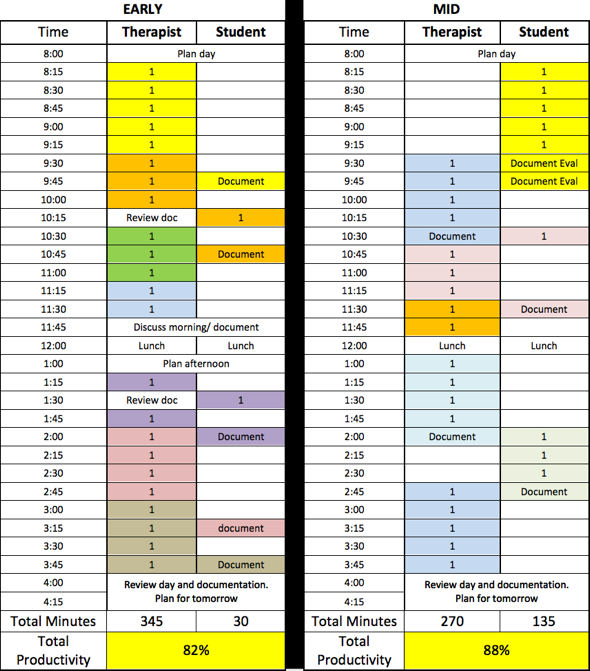
The schedules below show that even early in an internship the therapist and student team can carve out non-patient time for mentoring and still maintain a good productivity. Each color represents a resident treatment. As you can see all of the treatments are individual in this example. As the internship progresses and the student becomes more independent and has a larger caseload, the therapist will have time to do program development or other important tasks in the facility. The therapist must always be readily available to the student.

The Yellow Flag – Being Accountable

By Carissa Podesta, Compliance Officer

A couple of recent therapy compliance incidents caused some Ensign facilities to part ways with good therapists who made poor decisions.

I want everyone to know that these situations could have been avoided had those therapists sought help and support instead of acting in a way that placed their license and position in jeopardy. I personally feel bad that these individuals did not recognize that help and support existed and want to make sure that each of you understands what to do if you are ever in such a situation.

Holding Ourselves Accountable

Our Compliance Manual and Code of Conduct:

  1. Prohibits conduct that violates our policies or the law.
  2. Requires that we report any violations or suspected compliance violations.
  3. Prohibits retaliation against anyone who reports a compliance violation.

These standards are absolute and without exception. So, for example, we cannot violate policies or the law and then claim someone else made us do it. We also cannot fail to report a violation for fear of retaliation.

One of our organization’s Core Values is “Accountability.” We are asked to hold ourselves to the highest standards of care and professionalism. That means something more than just following policies or the law; it means acting ethically and with integrity in all of our actions as employees. Let this guide everything you do.

Our culture is one in which asking questions and challenging one another is encouraged. We will only become better if we make ourselves better. This means questioning the status quo and questioning anything or anyone that impacts our ability to act legally, ethically, with integrity or be accountable. This aligns wonderfully with our compliance responsibilities.

The take away – always report anything suspicious, always act legally, ethically and with integrity, never hesitate to question things and understand that there is never a valid excuse for doing otherwise.

Holding Others Accountable

At the conclusion of the two recent therapy compliance incidents, the therapists involved said they engaged in misconduct because (1) their supervisor told them to do it or (2) their supervisor made an unintelligent comment that was interpreted as a directive to act unethically.

If you believe anyone, even your supervisor, is instructing you to do something wrong, you must hold them accountable. Let’s apply the standards discussed above.

  1. Refuse to act on the request to engage in illegal or unethical conduct.
  2. If you feel comfortable, question or challenge the request. Tell the person why the request is inappropriate and use it as a teaching moment.
  3. If you feel uncomfortable, go to your operation leader, contact your local Therapy Resource or call the Compliance Hotline at 1-866-256-0955 (you may remain anonymous if you prefer).
  4. Be confident in the knowledge that you are doing exactly the right thing and that you are protected from retaliation.

The therapists involved in the recent therapy compliance investigations did none of the above. I truly wish they had understood that they were not alone, had another choice and had the complete support of this organization.

Questions and comments are welcomed. Contact: cpodesta@ensigngroup.net

Learning “Opptie” #4

WE LOVE OUR THERAPISTS! To learn more about the February Learning “Oppties” program, please read the introductory articleposted January 31. Today’s Learning “Opptie” is related to billing the proper mode of treatment. There are 3 modes of treatment defined in the RAI Manual: Individual, Concurrent and Group. Individual treatment is defined as the treatment of one resident at a time. The resident has the full attention of the therapist or therapist assistant for the treatment. Concurrent treatment for a Medicare Part A patient is defined as the treatment of two residents, who are not performing the same or similar activities, at the same time, both of whom must be in the line of sight of the treating therapist or assistant, regardless of payer. For Medicare Part B, however, the treatment of two or more residents who may or may not be performing the same or similar activity, regardless of payer source, at the same time is documented as group treatment. While group treatment for a Medicare Part A resident is defined as the treatment of 4 residents, regardless of payer source, who are performing the same or similar activities, and are supervised by a therapist or assistant who is not supervising any other individuals.

Whew! Did you get all of that information? Well, let’s put it into application with the following challenge:

Mrs. V, whose stay is covered by SNF PPS Part A benefit, begins therapy in an individual session. After 13 minutes the therapist begins working with Mr. S., whose therapy is covered by Medicare Part B, while Mrs. V. continues with her skilled intervention and is in line-of-sight of the treating therapist. The therapist provides treatment during the same time period to Mrs. V. and Mr. S. for 24 minutes who are not performing the same or similar activities, at which time Mrs. V.’s therapy session ends. The therapist continues to treat Mr. S. individually for 10 minutes. Based on the information above, what is the answer to the following questions?

—For how many minutes did Mrs. V. receive individual therapy? For how many minutes did she receive concurrent therapy?

— For which mode of treatment did Mr. S. receive 24 minutes? And, for which mode did he receive 10 minutes? (HINT: Use the Medicare Part B definition).

Learning “Opptie” #3

WE LOVE OUR THERAPISTS! To learn more about the February Learning “Oppties” program, please read the introductory article posted January 31. Today’s learning opptie is related to guidelines for recording minutes. According to the RAI Manual for MDS 3.0, v1.07, Co-Treatment minutes for a Medicare Part A patient should be recorded using the following rule: When two clinicians, each from a different discipline, treat one resident at the same time (with different treatments), both disciplines may code the treatment session in full. All policies regarding mode, modalities and student supervision must be followed. The decision to co-treat should be made on a case by case basis and the need for co-treatment should be well documented for each patient.

Describe a scenario with a Medicare Part A patient where co-treatment might be clinically indicated. Be sure to include the therapist or therapist assistants discipline(s), the total treatment time and how each discipline would record minutes. Have you ever participated in a co-treatment session with a patient?

Please be sure to blog your answer in the reply space below. Include your first and last name, your facility and your e-mail address (your e-mail address will not be visible on the website), to be entered to win your “Opptie”. THIS WEEK’S “OPPTIES” AWARD WINNERS WILL BE POSTED ON MONDAY, FEBRUARY 6. Be sure to check back.

Learning Opptie #2

WE LOVE OUR THERAPISTS! To learn more about the February Learning “Oppties” program, please read the introductory articleposted January 31. Today’s learning opptie is related to a tool used in Skilled Nursing Facilities to report the assessment of care and services required. It’s called the Minimum Data Set or MDS. The purpose of this manual is to offer guidance on how to code and use the Minimum Data Set Version 3.0 (MDS 3.0) correctly and effectively. The Centers for Medicare and Medicaid Services (CMS) has an electronic version of the MDS 3.0 RAI manual available on the website at cms.gov. Your MDS Nurse also uses an RAI Manual and will know the answers (or at least how to find the answers) to questions you may have regarding the MDS. Did you know that, according to the RAI Manual, the time required to adjust equipment or otherwise prepare the treatment area for skilled rehabilitation service is the set-up time and is to be included in the count of minutes of therapy delivered to the resident? Set-up may be performed by the therapist, therapy assistant, or therapy aide.

In Chapter 3, Section O, on page 18, the manual talks about recording minutes for set-up time and gives specific instructions on HOW to record set-up time. Use these instructions to answer the following question: Under which mode of treatment (individual, concurrent or group) should set-up time be recorded? Please be sure to blog your answer in the reply space below. Include your first and last name, your facility and your e-mail address (your e-mail address will not be visible on the website), to be entered to win your “Opptie”. Also, if you have any suggestions regarding some continuing education courses you’d like to see us bring to your area, please include those ideas in your blog, as well. Thank you for participating and HAVE FUN!

Learning Opptie #1

WE LOVE OUR THERAPISTS! To learn more about the February Learning “Oppties” program, please read the introductory article posted January 31. Today’s Learning “Opptie” is designed to inspire you to explore! On the front page of the www.ensigntherapy.com website under our knowledge tab, you will find a splinting workshop scheduled for sometime next month. What is the date of the workshop and where is it scheduled to be held? What are the names of the workshop instructors? What is the fee for therapists who work in facilities supported by Ensign Facility Services, Inc.? Please fill out the reply information below to be entered to win your “opptie”. Don’t forget to include your first and last name, your facility and your email address. Your e-mail address will not be published! Thank you for participating and don’t forget to check back tomorrow.

Splinting Workshop

NOR CAL~Be sure to register your interest in participating!

When:
Saturday, March 17, 2012
Note: Therapists and Assistants working for facilities supported by Ensign Facility Services, Inc. may register by e-mailing Kelly Wallerstedt at kwallerstedt@ensigngroup.net. There is no charge to Therapists or Assistants supported by EFSI.

Where:
Samuel Merritt University

3100 Telegraph Avenue
Oakland, California 94609

Instructors:

“Ginny” Karen Gibson, MS, CHT, OTR/L

Ginny is an assistant professor in the Department of Occupational Therapy. She has developed and teaches curriculum including kinesiology and biomechanics, evaluation and treatment, physical agent modalities, and advanced splinting, as well as other courses relative to pediatric populations. She also served as a lab assistant in anatomy and physiology, including cadaver dissection and lectures on upper extremity. She proposed, developed and served as program director for the Certificate Program in Examination, Assessment and Intervention of the Hand and Upper Quadrant. Ginny is currently the serving as the senior occupational therapist at Children’s Hospital and Research Center in Oakland, CA, where she led the expansion of the outpatient OT department to include an Occupational Therapy Hand Clinic.

Nancy Chee, OTR/L, CHT

Nancy graduated in 1982 from Tufts University – Boston School of Occupational Therapy and is currently working as an Adjunct Assistant Professor for Samuel Merritt University. Having worked as an OT in areas of adult day health, home health, acute rehabilitation and hand therapy, Nancy is currently at California Pacific Medical Center Hand Therapy Department working with patient with acute and chronic hand injuries. Throughout her career, she has presented lectures/presentations for national, state and local organizations. Specific areas of interest include acute hand trauma and splinting, volunteer work through non profit organization, Interplast as a hand therapist working in developing countries to bring medical services to patients and teaching to local MDs in the area of post surgery management and hand therapy treatment.

Continuing Education Units:

You can submit 8 countact hours/.8 CEU’s to the California Occupational Therapy and Physical Therapy Associations. Provider number and certificates will be provided upon the successful completion of the workshop and we have submitted for advanced CEU approval.

Learning “Oppties”

WE LOVE OUR THERAPISTS! And, to CELEBRATE our PASSION FOR LEARNING, therapists, assistants and therapy techs working in facilities supported by Ensign Facility Services, Inc., will have the opportunity to LEARN AND WIN. In the July 2010 issue of Spirit Magazine (Southwest Airlines), Jay Heinrichs authored an article about a concept of giving back to employees by rewarding them with something that can help make them a little better. Heinrichs termed these rewards, “oppties”. We loved the idea and WE LOVE OUR THERAPISTS! So, for each day during the month of love (yes, February), a new learning opportunity related to various topics will be posted to the “LEARNING OPPTIES” page on www.ensigntherapy.com. Read the message, review the question and blog your response by hitting the “Discuss” link. You can also fill out the “reply” section located just below the question. Timely and correct responses will be entered to win “Oppties”. In addition to individual winners, there will also be other “Oppties” awarded, such as highest number of participants from a facility therapy department over a period of time and teams with the most consistent participation throughout a period of time. Winners will be posted. Don’t forget to check us out at www.ensigntherapy.com each day, beginning February 1, 2012, for your opportunity to LEARN AND WIN!