Ensign’s Best: A View of the Future

In the past year, Vista Knoll Rehabilitation has expanded its knowledge base by hiring a Physical Therapy Assistant, Michael McFadden, MS, PTA, Certified Polestar Rehabilitation Practitioner, Gold Certified PMA-CPT. Michael is an expert in Pilates, bringing a breath of life and new ideas to promote the success of our patients. Our goal is to position Vista Knoll Rehab as the future of skilled nursing and rehabilitation settings for physical and occupational therapy by providing a diverse treatment approach directed toward each individual patient. Treatment incorporating Pilates principles and providing an environment conducive to helping patients to return to their prior level of function is essential for today’s progressive and successful therapeutic model. At Vista Knoll Specialized Care facility in Vista, CA, the therapy team took a chance in the department and soon saw the results of a progressive, intuitive rehab approach in Pilates that brought its residents a unique approach to recovery.

The Vista Knoll patients and residents have benefitted from utilizing the Pilates principles and equipment that facilitates treatment goals of improving functional mobility, progressing independence and an integration of core principles for centering, alignment, posture, control, concentration, balance and breath. These pathways provide a power of healing that is optimal and often beyond expectations. Staff, visitors and residents are often impressed and surprised with this “new” clinical model. Because of the many diverse diagnoses at Vista Knoll including orthopedic, cardiac, diabetic, amputee, CVA, pulmonary and cognitive deficits, the Pilates approach offers the flexibility and creativity needed for patients’ progress.

Michael feels Pilates and its apparatus have been overlooked in skilled nursing settings but hopefully soon will be the standard for clinicians who can seek professional coursework and adapt their ideas and methods for the betterment of patient care. Mobility, restoring range of motion, movement patterns and core integration with attainable results in a timely and cost-effective period are essential in the rehab world today. As a result of using the Pilates equipment, which is mostly spring-assisted, patients are able to pattern hundreds of repetitions to re-educate pathways and motor control in all planes and assist levels. This movement awareness and availability has functional carryover for therapeutic goals and discharge with a home program for all levels and family participation.

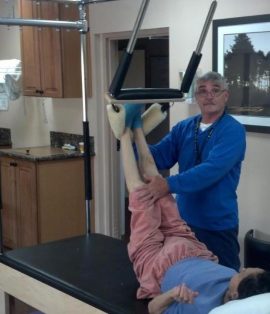
In our rehabilitation setting, including physical and occupational therapy, we have introduced wall springs and the trapeze table, affording staff multiple stations for treatments. Our high-risk population benefits from strength and balance options in which we utilize creative means to engage participation and safety awareness. Daily treatment includes the methods from both disciplines, which also provides for strong team-building and carryover of ideas. Sit to stand from the wheelchair at one end of the trapeze table with bilateral poles, push-thru bar on the other end in standing or sitting position, and supine leg series on the table all can be performed simultaneously, which is also helpful in small treatment areas.

Here at Vista Knoll, the benefits of our Pilates environment has been evident and has given our residents and returning outpatients the quality-of-life outcomes we strive for as clinicians.

by Kirsten Chesney, DOR, Vista Knoll Specialized Rehab Care, Vista, CA
Dementia Capable Care – Helping to Correct Negative Behaviors

Working as an occupational therapist with individuals with dementia is challenging when it comes to finding effective techniques for connecting with the client and enabling them to reach their maximum potential. So it was a pleasant surprise when I recently had the opportunity to partake in a Dementia Capable Care seminar with other therapists in my cluster. I was educated on effective communication, treatment planning and care techniques to bring out the best ability to function in persons with dementia, enabling me to create more rewarding and successful outcomes for my clients.

Shortly after I took the class, a client with dementia was referred to OT services due to her continual refusals of bathing and her aggression once she was in the shower. Although the case seemed challenging, I was eager to apply the new information and strategies that I had learned to my new case. Immediately, I wanted to discover the causes of the behavior. Was it that the resident was feeling frightened, vulnerable or cold? I knew that my skilled observation and my ability to build a strong rapport with the client were essential to finding the necessary information.

I spoke with the patient about family, friends, her current living environment, likes and dislikes, etc., to gain an understanding of her life story. I took this information, together with my knowledge of her Allen cognitive level, and began to devise a plan to reduce the triggers of the difficult behaviors. After skilled observation, assessment, communication and consultation with the resident, with members of the interdisciplinary team and with the patient’s CNAs, it appeared the negative behaviors were forming as a result of the patient having a lack of control, and her difficulty transitioning quickly to a new task. When the client was approached for a shower, there was a demand for immediate performance. Due to the client’s dementia, she had the belief that a shower was just taken the day before; she had no understanding of why it was required again. It also was observed that the client had no time to prepare for the shower, as the approach was too sudden. Because of her cognitive impairments, she required time to transition to the new task and benefited from context cues. In learning about her values and beliefs, it became clear that the client also was very modest in front of men and would deny any bathing task that would include the male gender.

Using what I knew about my client and the techniques learned in the Dementia Capable Care class, I began my approach with the critical step of rapport building, as gaining the client’s trust was critical. Our visits always started with a conversation about the day or how the client was doing, before any mention of a shower. The client was seen approximately an hour before the shower was to occur to give her a sense of preparation, and to decrease any feelings of anxiety due to being rushed.

During our visits, I consistently acknowledged the client’s concerns and took note of facial expressions and body language, offering a positive redirection if negative behaviors or actions began to occur. In addition, I visited the client even on days a shower was not required, so I would not be negatively correlated with a shower each time. We used a calendar as a visual aid, and I asked the client to select and mark down days and times at which she would be most comfortable taking a shower. She was given a choice of shower rooms, clothes and any other particulars she would prefer in order to make the environment pleasant.

The client responded well to these measures as well as to my positive attitude and smiling face. She even reported to me during one session, “Although I do not want to shower right now, I can’t say no to you,” as a result of us building a trusting, respectful relationship. The client’s false beliefs were not battled, but rather redirected to a positive action.

by Chantal Thomas, OT, Sonoma Healthcare Center, Sonoma, CA

Team Building at Park Manor

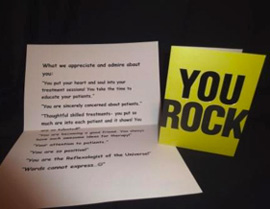
Ever feel at a loss for words when wanting to express your appreciation for your awesome therapy team? Sonya Taylor at Park Manor Rehabilitation Center in Walla Walla, WA, found a way to allow for her therapists to express their gratitude and appreciation for one another using a team building exercise that turned 360 degree feedback into 360 degree love for one another. Each therapy staff member wrote down one thing they appreciated or admired about each team member. Sonya then gathered the notes and wrote them on individualized “You Rock” cards for every team member. What a great way to highlight and celebrate the unique strengths of your therapists!

Massage Vibration Brings New Life to Northern Oaks

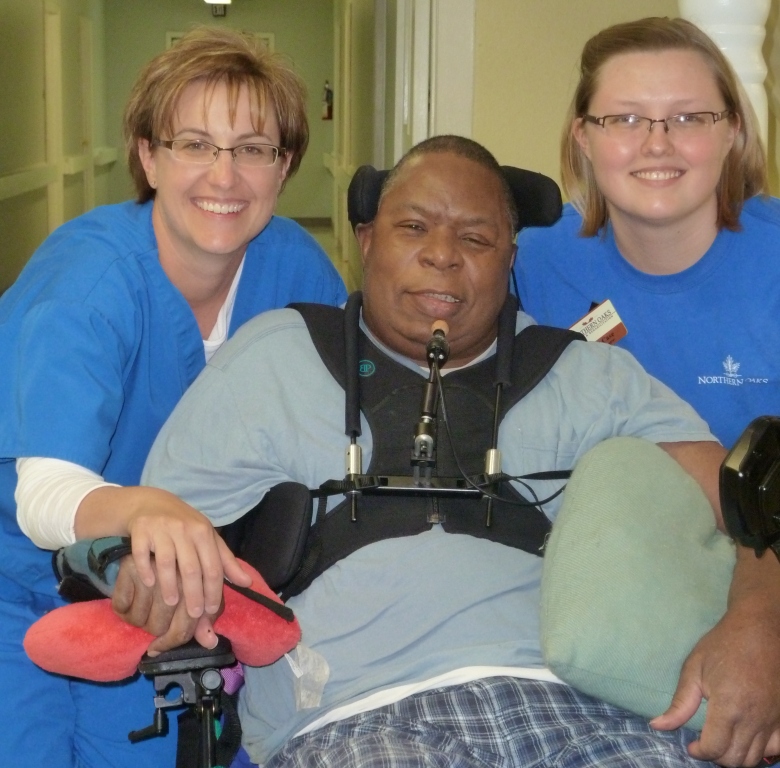
by Billye J. Alford-Lee, DOR, Northern Oaks Living & Rehab Center, Abilene, TX – Mr. Lynn has been a resident at Northern Oaks for three years with a diagnosis of quadriplegia — he has struggled with seating issues due to extensor tone in UEs and LEs. After consulting with resources Deb Ellis and Jon Anderson, we trialed a massage/vibration mat to decrease tone prior to ROM and began assessment and fitting for a new custom power wheelchair. The vibration mat worked beautifully if applied approximately 20 to 30 minutes prior to treatment. The custom power wheelchair arrived five weeks later, with a head array and mouth control driving mechanism, allowing Mr. Lynn a newfound independence in mobility and quality of life that he had not experienced in several years. He also is able to control his television with the mouthpiece, as it is synced with his remote control.
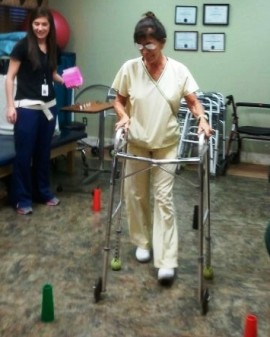
Our therapy team has been so honored to work with Mr. Lynn in making a difference in his life. His amazing attitude and smile are such a joy to see, and the creative efforts of Ensign Therapy Resources and therapists have truly contributed to enhancing his comfort, independence and happiness here at Northern Oaks!

Celebrating OT Month at Osborn Health and Rehab Center

by Joleen Linn, Therapy Resource

As many of you know, April was National Occupational Therapy month. In an effort to provide education to the staff on the role of Occupational Therapy in a SNF setting, Osborn Health and Rehab Center hosted a week of fun and informative activities for their co-workers and residents. Occupational therapists provide extensive education to their patients and family members as part of their treatment plans, but how many times have you heard OT introduced as, “This is OT — they work with you ‘above the waist.’ Osborn Health and Rehab Center wanted to inform their staff that occupational therapy is more than “arm bikes, peg boards and getting people ready for PT.” They felt that the best use of OT month was for staff education.

First, they did a quick presentation at their all-staff meeting and invited everyone to participate in the week’s daily activities. The OTs and COTAs made up an OT-related word search, crossword puzzle and true/false quiz. As employees completed the activity, they were presented with a “prize” consisting of chips or cookies (yes, they did bribe with food!). Then each day, Osborn Health andRehabCenterpresented an activity that demonstrated how various impairments affect their residents’ ability to complete basic tasks. For example, they mimicked visual deficits (blindness, macular degeneration and glaucoma) while the staff member navigated an FWW through an obstacle course and then sat down to complete a drawn maze. Another day’s activity involved dominant-sided weakness post-stroke. The employee had to use his or her non-dominant hand for a balance, gross-motor, eye-hand coordination task, which consisted of balancing on one leg on an unstable surface and tossing bean bags with the non-dominant hand to win various prizes. Other activities performed that week included a fine-motor “Minute to win it” type of game, and finally a speed, visual perceptual/cognitive task followed by root beer floats as the final reward.

The Occupational Therapy team did an excellent job of staff education, and more than once heard the comment, “Wow, is that what it is really like?” They had a good turnout and a lot of fun in achieving the objective of celebrating OT month and showing off OT!

Mentoring is an Opportunity for Both Therapist and Intern

By Amy Lynn Gutierrez, SLP, Village Care Center, McAllen, TX –

I have been a practicing SLP for the past six years and have had the pleasure of working for Village Care Center in McAllen, TX, for five years. In 2011, I was presented with the opportunity to mentor a new graduate who was seeking to complete her CFY. I have to admit, initially I was a bit apprehensive as I did not feel I possessed the “tools” to educate and/or mentor a fellow clinician.

On July 11, 2011, Denise joined our team as an intern in Speech-Language Pathology. She has since then been a wonderful asset to our work family. Being a recent graduate, she has provided not only me, but also our whole team, with unique treatment approaches along with a different perspective. These past nine months have flown by so fast, it is astonishing to believe that it has come and gone. I remember her first day and how reluctant I was to provide her with her own list of patients. My director said to me: “She’ll be fine. You can’t follow her around forever, and you need to give her more than three patients!” I couldn’t help but recall when I was an intern and how terrified I was; she must have been feeling the same way. Slowly but surely, I let go of the reins and realized I would always be within walking distance in case she needed anything. I am very fortunate to have had such a wonderful first experience with my CF. We had many adventures together that provided us with a number of teaching moments.

The most important thing I learned throughout this experience is that we won’t always have the immediate answer, and that fear should not hinder us from taking on a task that may seem challenging. My apprehension toward becoming a mentor was unwarranted. I now understand that mentoring a fellow clinician should be viewed as a privilege. It’s a learning experience for supervisor and intern both and an experience we will both carry with us.

The Human Side of Physical Therapy

Physical therapy school prepares you by giving you that archetypal “toolbox” filled with various resources and skills to be constantly adjusted and fine-tuned. The more tools, the better! Since every patient is unique, each treatment must be tailored to deliver the best interventions possible. During various courses preceding my first clinical internship, I filled my toolbox with functional outcome measures, neurological interventions and about 50 pneumonics to remember everything from the cranial nerves to the eight carpal bones. I practiced NDT, PNF, MMTs and goniometry on my classmates at length, sweated through practicals and wrote hundreds of study guides. I felt eager to apply this knowledge to actual patients, not my unimpaired classmates, so that I could learn from experience. My first internship brought me to Sonoma Healthcare Center, an Ensign-affiliated sub-acute skilled nursing facility.

As a student embarking on my first internship, I had some expectations of what I should gain out of the seven weeks I was to spend at Sonoma Healthcare Center. I expected to learn, to be challenged applying my knowledge, to experience a wide variety of patients and their unique impairments. What I did not expect was that my experience would take me above and beyond these conjectures and give me an opportunity to not only utilize my “tools,” but also to foster meaningful relationships with both my peers and my patients. It’s the human side of physical therapy: that knack for communication, the willingness to have an open heart. These are skills no professor can teach — skills that only can be gleaned by experiencing firsthand a patient with C-Diff precautions who doesn’t want to feel socially isolated, a patient who looks to you to teach her how to deal with an amputation, a patient who struggles with panic and fear of falling with every sit to stand. Sonoma Healthcare Center opened up a world in which each patient demanded my skilled interventions, my creativity and above all my compassion. I knew that these skills would shape my career as a PT. To ensure that these skills were honed and refined during my time at SHC, I looked to my mentor and clinical instructor for guidance.

My clinical instructor, JB Chua, has been an incredible teacher because he teaches by example. JB understands that aforementioned human side of physical therapy. He harbors great respect and obvious compassion for his patients, as well as an infectiously positive demeanor that is difficult to ignore. And for these reasons, his patients adore him. As a mentor, he has been a terrific role model as I strive to achieve such a rapport with my patients. JB’s willingness to take me on as a student, and his undying patience as I worked through documentation and clinical reasoning, have created an environment in which I have learned more than I could ever have hoped for. So I have to thank my clinical instructor (and the rest of the stellar rehab team with which I have been honored to work, and whom I am proud to call my friends) for such an educational — and memorable — clinical experience. The bar has been set high for my future clinical experiences, and my future as a physical therapist. Thank you to Sonoma Healthcare Center for bringing me into your rehab family, taking my toolbox beyond pneumonics and study guides, and providing me with an example of the clinician I aspire to become.

by Courtney Sinclair, SPT Student Intern at Sonoma Healthcare Center, Sonoma, CA

I have really enjoyed my experience at Park View Gardens and have learned so much more than I could have imagined about practicing in a skilled nursing environment. This was completely new for me since my experience has been primarily in an outpatient setting, and the staff at Park View Gardens welcomed me with open arms and helped me to really get the most out of this opportunity.

by Shelby McCalla, SPT Student Intern at Park View Gardens, Santa Rosa, CA

It was a great experience for both me and my CI. Her vast clinical knowledge, mixed with my resources and fresh ideas from school, made for an ideal pairing to offer the best clinical approach in patient care.

by Murphy McCarty, SPT Student Intern at Cloverdale Healthcare Center, Cloverdale, CA

Bridging the Gap: Clinical Research and Rehabilitation

by Curtis A. Merring, DOR, Wellington Place, Temple TX –

Professionals and administrators in any rehabilitation setting need intrinsic motivation to pursue evidence-based treatment strategies to stay ahead of market adjustments and reimbursement trends. In our current healthcare system of cost-cutting and cost-saving payers such as Medicare (the lifeline of skilled nursing facilities), it is only a matter of time before regulators request from facilities quantifiable results of treatments. Active participation in this process, including preemptively taking these steps, will put any organization or facility at an advantage.

In my experience as a therapist, it has been rare to witness therapists who review current research when planning their treatment strategies, and current trends show no remarkable change in their approach. This is problematic for both established therapists and new graduates entering the field. Therapists in the field are used to the status quo of not integrating research or evidence. New graduates, equipped with the newest evidence- based treatment strategies and the know-how for obtaining this information, come into a field that is dominated with non-evidence-based practice. As clinicians with the least experience, they are challenged with implementing research-based treatment among the norms of existing therapists, not to mention many superiors who have routinely practiced non-evidence-based practice. Shifting the paradigm will require a change in our culture.

At Wellington Place Living and Rehabilitation, our staff has accepted the challenge of integrating evidence into our practice. The rehabilitation department actively engages in addressing the above stated challenges in the following ways. First, all disciplines have at least one evidence-based outcome measure they are responsible for using, tracking and reporting on to objectively measure progress in addition to and in support of less objective functional level measurements (e.g., Min A, Mod A). Next, a relationship has been established with Texas State University through my current collaboration and consistent, open dialogue regarding new treatment strategies and proven innovations in practice. Also, all therapists are encouraged to attend courses with strong evidence-based, progressive topics and present on them to the whole staff upon completing the course. Applying these steps in order to increase evidence-based practice in our department has increased accountability for both the staff and me. In return, we have been able to provide a better service rooted in proven rehabilitation strategies.

The Lodge at Willow Bend

by Jessie Dees, DOR, Willow Bend Nursing and Rehab, Mesquite, TX –

For months now, I have wanted to sit down and type up this article to share my thoughts and reflections on Willow Bend’s Rehab Department. I have been here for 15 months, and looking back, we have come so far. I walked into a department that was struggling to maintain a caseload and keep current on paperwork, while also considering an addition to the building that was a concrete slab and wood studs. Today, our department is quickly growing with team-oriented therapists and techs. Our long-term, short-term and outpatient caseloads continue to expand faster than any of us ever imagined. The timeliness of paperwork completion is much improved through numerous systems we have developed, implemented, and continue to modify. We have improved our presence within the building and in the community.

On January12 of this year, we accepted our first patient into “The Lodge,” our newly renovated Rehab space. We were all excited at the future possibilities and secretly anxious about the unknown. The Lodge has been a great learning experience filled with indescribable opportunities and lots of “growing pains.” As a physical therapist and a Director of Rehab, this opportunity is a dream come true. I am truly grateful to be able to work with a staff that is team-focused and willing to go above and beyond to provide quality treatment to patients. The facility is likewise a therapist’s dream and allows us to expand our creative therapy minds to focus on individualized care. Our therapy courtyard is both functional and provides entertainment and serenity for our patients. The state-of-the-art gym and equipment are exciting for both patients and therapists. The Lodge also has a full-functioning ADL apartment. It provides a great opportunity for patients to perform home tasks in a safe environment and to allow therapists to assess that the tasks are safe and that the patient is truly ready for a safe discharge home.

We accepted our first outpatient this past week with hopes of developing a truly successful outpatient department, not merely a SNF that offers outpatient care. I know that there will be challenges in the development of this program, but I am looking forward to continuing to grow with my team as we forge on into this new area.

It is important to acknowledge and thank all of the other departments at Willow Bend. They have supported the rehab department and have grown with us. Kevin has been nothing but supportive of our department from Day One. We tackle “bumps in the road” together, and while we might not always see eye-to-eye, we are always passionate about our patients and the care we provide.

I am truly excited about our future as a facility and a department. I know there will be long days ahead, some filled with headaches and others with laughter. I am confident that we will continue down the path together, keeping our patients’ best interests at the center of our thoughts, driven by our desire to continue to provide excellent service to our patients, their families, our employees and the community. If you ever find yourself in the Dallas area, please stop by and visit us. We would love to meet you and show you around!

Educational Journey

by Jesus Rodriguez, OT, Grand Terrace Rehab and Healthcare, McAllen, TX –

Getting an education can be a challenging experience for many. Imagine adding other factors to the equation, such as family and full-time employment. This can make it difficult for those who work and attend college to be successful in achieving that goal. In addition, many believe that the traditional route of getting an education going from high school straight through college still exists. However, this is not true. Many students are now obligated or choose to work in order to pay for school or to avoid loans. Furthermore, not everyone chooses to go to college after high school or complete a higher education at once. This is true for me.

My road to getting an education has been a journey. I graduated from an occupational therapy assistant program in May 1999 and initiated my practice shortly thereafter. After a few years off, I received a second associate’s degree in interdisciplinary studies in 2004. I took some time off to allow my wife to attend college and get her degree, and then I started school again on a part-time basis, wanting to continue my education but not knowing in what discipline. I finally chose to go back to OT school and earned a Bachelor’s Degree in Health Service Technologies in 2008. In 2009, I initiated the COTA to MOT bridge program at Texas Woman’s University in Denton. I am graduating this year and with great feelings of relief.

The process of continuing your education can be a tedious and challenging one, but it’s well worth it. It starts by ensuring that you have the self-discipline, self-motivation and determination to start and finish what you undertake. It also takes much planning with your family in order to ensure that all the finances, roles and family responsibilities fit in with this venture, and that everyone is willing to sacrifice themselves and understands what is about to happen. Remember, you are not doing this alone if you’re married and have kids; your family does it with you.

After you’ve finalized your decision of going to school, the second step is to gather the information needed to apply to the program such as requirements for application, the application process, and information on the process of completing the educational and clinical coursework. Thereafter, once you are accepted into the program, take time to organize your work, family and school life and prioritize the times allotted for each in order to succeed in the different roles you will have to assume. As for me, after many years of hard work, long work hours, late nights, sports practices and games, white hairs, and four kids later, I am finally DONE!